


In a recent interview, Geoffrey Hinton, the “godfather of AI” and newly minted Nobel laureate, didn’t mince words.
The companies leading the artificial intelligence boom, he warned, aren’t investing trillions to make our lives easier or our jobs better. They’re betting on something far simpler: that replacing people with machines will be the most profitable business model in history. The obvious way to make money off AI, Hinton said, is to replace workers with something cheaper.
It’s a statement that crystallizes the quiet truth beneath the AI gold rush, one that’s been hiding in plain sight amid the euphoria of large language models, infrastructure deals, and AI copilots. While AI can create new possibilities, the incentive structure driving its adoption is not designed for balance but for efficiency. And efficiency, at scale, almost always comes at the expense of human labor.
The New Logic of Profit
The numbers are staggering. The four AI “hyperscalers” — Microsoft, Meta, Alphabet, and Amazon — are expected to boost their collective capital expenditures from $360 billion this year to $420 billion next year, according to Bloomberg. Meanwhile, OpenAI has announced $1 trillion in infrastructure deals, a figure so large it sounds almost fictional.
Hinton’s conclusion is blunt: these investments only pay off if AI replaces human labor on a massive scale.
That framing reverses the usual optimism about technological revolutions. When steam power or electricity arrived, new industries emerged — factory jobs, railroads, communications. But this time, Hinton isn’t convinced that AI will create enough new forms of work to offset what it destroys.
And the early evidence agrees. Entry-level job postings in sectors most exposed to automation — marketing, design, law, and finance — have dropped by nearly 30% since ChatGPT’s launch. This isn’t just about automation of repetitive tasks but about the erosion of apprenticeships — the foundational rung of every profession.
At the same time, Amazon recently announced 14,000 layoffs, primarily in middle management. CEO Andy Jassy framed the decision as cultural, not technological, yet an earlier memo he wrote hinted otherwise: “As we roll out more Generative AI and agents, it should change the way our work is done. We will need fewer people doing some of the jobs that are being done today, and more people doing other types of jobs.”
AI isn’t just a productivity tool but a new kind of industrial revolution — one that automates the very cognitive functions we once considered uniquely human.
The Collapse of the Old Labor Contract
For over a century, the implicit social contract was simple: Work hard → gain experience → earn security. That linear promise built the middle class and shaped how we educate, train, and measure human worth. But in a world where AI can design, analyze, code, write, and very soon, reason, the idea of a stable “career ladder” collapses.
The old model: education → employment → retirement, no longer holds. Instead, the 21st century is giving rise to what might be called the Age of Replacement:
Work is unbundled: Tasks, not roles, are automated.
Careers are fluid: People assemble work portfolios instead of linear resumes.
Productivity decouples from employment: Companies grow profits without growing headcount.
Human value fragments: The premium shifts from skill to adaptability.
In this new landscape, individuals who can harness AI become exponentially more capable — the “AI-leveraged elite.” But for everyone else, especially those dependent on traditional employment structures, the floor is giving way.
And yet, amid this disruption lies an extraordinary opportunity — if we rebuild the foundation.
Reinventing Education for the AI Century
Where Hinton diagnoses the collapse, Peter Diamandis offers the cure. In a 2015 conversation with Tim Ferriss, Diamandis argued that our education system was designed for a factory economy, not an exponential one. Bell schedules, standardized tests, and rote memorization trained compliance — not curiosity. We teach children to follow instructions, not to question them.
“The problem,” he said, “is that we’re preparing kids for linear careers in an exponential world.” That was 2015. Today, his warning feels prophetic.
As AI reshapes the landscape of work, the institutions built to prepare people for it — schools, universities, and corporate training programs — are falling behind. If Hinton’s thesis is that AI will end work as we know it, Diamandis’s counterpoint is that education must reinvent humanity as we know it.
He called for a shift toward “just-in-time” learning — the ability to acquire knowledge when it’s needed, not years before. For teaching emotional intelligence, creativity, collaboration, and curiosity — precisely the qualities that machines cannot replicate.
Education, in this framing, is not a finite phase of life but a continuous state of becoming. And the sooner society embraces that, the more likely we are to turn Hinton’s dystopia into something closer to a renaissance.
From Replacement to Reinvention
When we fuse Hinton and Diamandis, the future unfolds in two parallel arcs — one economic, one human:
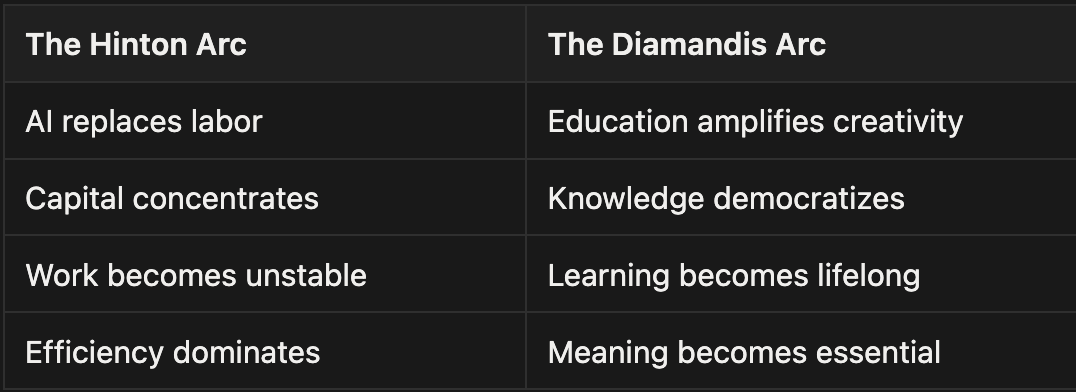
The tension between the two arcs defines the decade ahead. If Hinton is right about the trajectory of capital, and Diamandis is right about the power of human potential, then our challenge is not to slow technology, but to accelerate adaptation.
That means reimagining education not as a pipeline into jobs, but as the core operating system of civilization.
The Builders’ Mandate
For founders, educators, investors, and policymakers, the call to action is clear.
1) Build for human-AI collaboration: The most significant opportunities won’t come from replacing humans, but from amplifying them. The next wave of billion-dollar companies needs to be human-AI hybrids — organizations designed around orchestration, not substitution.
2) Rebuild education as an ecosystem, not a factory: The future of learning is personalized, project-based, and AI-augmented. Imagine a 12-year-old in Lagos or Lima learning from an AI tutor modeled on Sal Khan’s vision, while building projects with peers across the world. That’s the new classroom.
3) Reward adaptability, not credentials: We must stop confusing degrees with capability. The most valuable trait in the Age of Replacement isn’t what you know but how fast you can learn something new.
4) Redefine “career.”: The 40-year linear path is gone. The future is a mosaic: bursts of projects, start-ups, collaborations, sabbaticals, and retraining. Institutions that enable fluidity will shape the new social fabric.
5) Embed moral and civic purpose: AI may outthink us, but it cannot outcare us. The new frontier of education must reintroduce ethics, empathy, and responsibility as central tenets of human development.
What Comes After the Job
The most profound shift will be existential, not economic.
For centuries, work has been the organizing principle of modern life. It determined identity, status, meaning, and community. If AI undermines that, what replaces it?
Perhaps the answer lies in creation itself.
In a world where machines produce, humans may rediscover what it means to imagine. The future of education, then, is not about training workers, but about cultivating builders, caregivers, and citizens — people who design systems aligned with human flourishing.
In Hinton’s words, “The problem ultimately is not due to AI itself, but on how we organize society.”
That organization begins with what, and how, we choose to teach.
The Renaissance Ahead
The Age of Replacement is real, but it doesn’t have to end in despair.
If we get this right — if we rebuild education for imagination, curiosity, and adaptation, we might not just preserve work, but transcend it. We could usher in an era where human purpose isn’t tied to productivity, but to progress.
As Diamandis put it, the goal is not to prepare children for jobs that may not exist, but to prepare them to create the future itself. That is the essence of existential innovation. Not resisting what’s coming, but reinventing what it means to be human within it.
Because the future won’t fix itself.
We will.
With belief,
Yon
👋 Hello! My mission with Beyond with Yon is to help solve humanity's greatest existential challenges and advance the human condition. Connect with me on LinkedIn and X.
Thumbnail Credit: Freepik